Document-Driven Development & Integrated Scoped Wiki
A document-driven development architecture with an integrated scoped wiki. Requirements are written in Markdown; the attached AI IDE (e.g. Cursor) generates agents strictly following best-practice templates.
Concept & Purpose
Writing agent logic without clear specifications leads to AI "hallucinations" and inconsistent system structures. YAIFA enforces a "Documents First" paradigm:
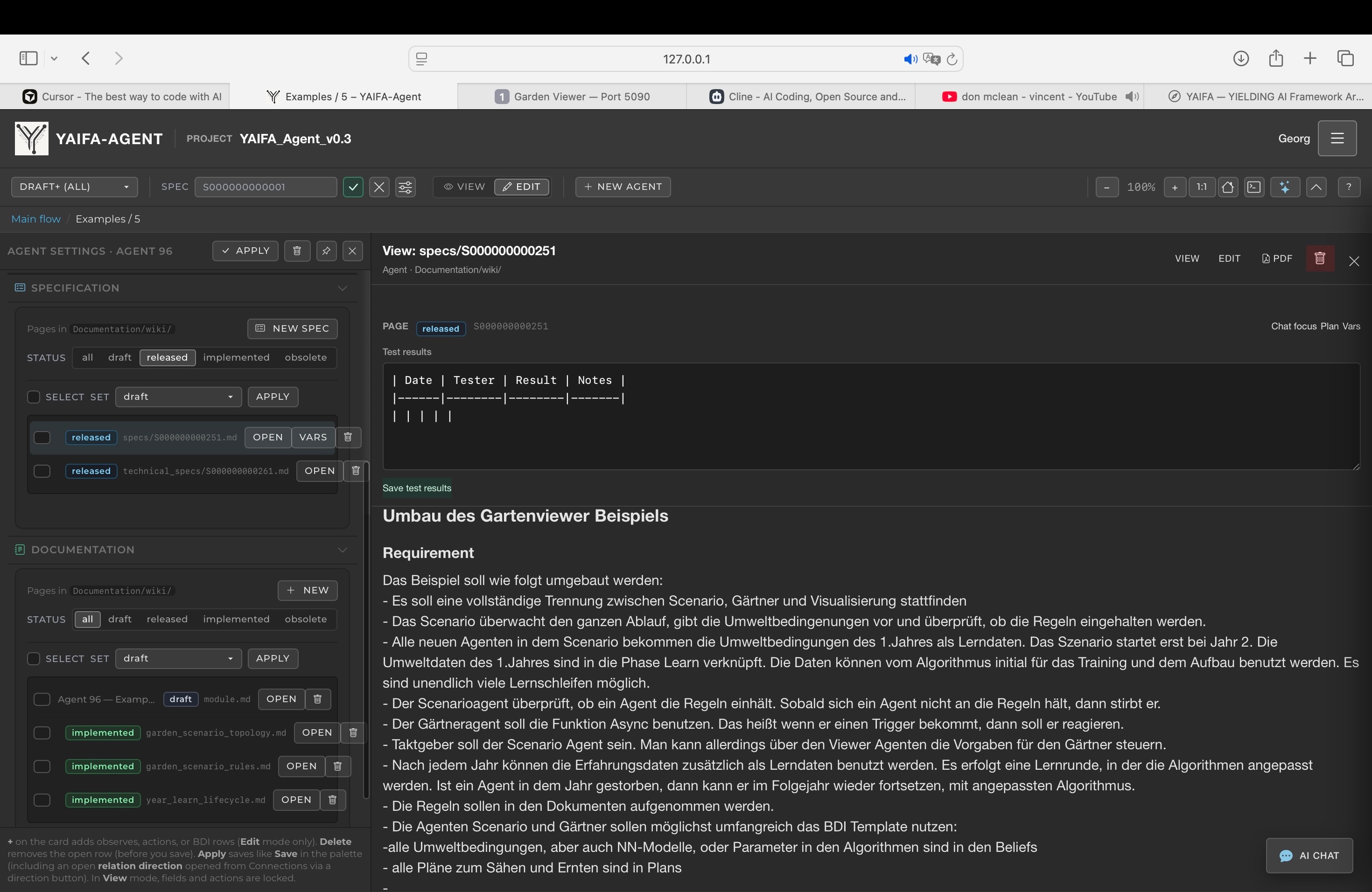
Requirements, architecture layouts, and expected input data are written in standard Markdown files inside the project's integrated scoped wiki. The attached AI IDE (e.g. Cursor or VS Code equipped with YAIFA rules) reads these documents as direct semantic context. Instead of inventing structures, the AI acts as a system filler, populating predefined templates and code stubs based strictly on the wiki specification.
The YAIFA Method (Document-Supported MAS Construction)
The YAIFA method is the methodical core of the framework: a Multi-Agent System is built document-supported and with LLM assistance. A persisted model, versioning, and release gates support safe operation.
| Principle | Meaning |
|---|---|
| Documents first | Specifications, Scoped Wiki (Project/Agent/Element) and planned data examples are machine-readable context for humans and LLM — not just a manual. |
| Structure before implementation | Agent dummies (skeletons, templates, draft agent.json) define rough structure, ports, relations, and data flows before business logic is complete. |
| LLM as filler | The LLM generates and supplements configuration and code within the YAIFA schema: classes, BDI rows, processing modules, business logic — Config first, Generator second. |
| Iterative Draft and Learn phases | Design (Draft) and Learn can be run through multiple times: refine structure → train → re-adjust — without re-inventing the entire agent. |
| Simulation as quality gate | The simulation phase verifies logic and MAS behavior and prepares production operation; on updates it is repeated (regression). |
| BDI as exchangeable layer | Beliefs, Desires, and Plans are versionable components — individual parts (e.g. only the plan) can be exchanged; old and new plan can coexist in a lineage until simulation and release secure the transition. |
| Classification at BDI hooks | Element Classes check structurally and at runtime whether adoption and plan selection are permissible — BDI becomes typed, not just textual. |
| Logging as learning loop | BDI Runtime Logs and business logs are feedback: evaluation leads to new Beliefs, Desires, Plans, and configuration changes — again via the same BDI and classification logic. |
| Executable BDI artifacts | BDI objects are not dumb text messages: Beliefs, Plans, and Port-Processing can be newly trained neural networks, Python programs, rules, and structured payloads — hybrid in the same template. |
Guiding principle: Describe and scaffold (Documents + Dummies) → LLM fills classes and logic → Learn and Draft iterate → Simulation releases → Logs improve the model.
The Three-Layer Wiki Structure
The knowledge base of a YAIFA project is structured into three clear levels, providing hierarchical context for the AI developer loop:
| Wiki Level | On-Disk Location | Role for the AI Assistant |
|---|---|---|
| 1. Product Specification | documentation/wiki/ |
Global rules, validation parameters, and system boundary parameters. |
| 2. Project Wiki | /Documentation/wiki/ |
General MAS architecture, active agent roles, and data flow topologies. |
| 3. Agent / Element Wiki | <agent_dir>/Documentation/wiki/ |
Detailed descriptions of specific inputs, BDI slots, and expected processing steps. |
Technology Focus — Manufacturer Independence
YAIFA focuses on Python, JSON, and YAML as normative artifacts. This keeps the system manufacturer-independent. LLMs can optimally support the development process because schema, generator, and common patterns are machine-readable. The user describes data and functionality in their preferred language. The LLM creates Python code from this, allowing arbitrary business logic and complex problem solving without limits of a visual sandbox.
Technical Realization
During the Design (Draft) phase, developers follow a standard workflow to create and deploy agents:
- Write Specification: Draft the agent's responsibilities, input schemas, and plans inside the scoped Agent Wiki.
- Create Skeleton: Create a basic
agent.jsonconfig mapping only names and port outlines (manually or via a template). - Invoke AI Filler: Let the AI assistant read the Wiki and fill in the detailed
agent.jsonparameters, BDI rules, and processing logic drivers. - Run Code Generation: Trigger the studio generator, compiling the verified
agent.jsonconfig into executable Python driver templates.
The absolute source of truth remains the declarative config (agent.json) and the specification document, rather than chat logs or temporary prompt memories.